The first five years of life are often described as the most important for a child’s growth, and for a good reason. During this time, children’s brains develop faster than at any other stage, creating the building blocks for lifelong learning, health, and wellbeing. From their very first smile to their first day of school, every milestone is a sign of progress in areas such as communication, movement, problem-solving, social skills, and emotional understanding.
At Children First Early Education, we see these milestones as moments to celebrate and opportunities to nurture. Our Educators are trained to recognise and support each stage of development, tailoring experiences that inspire curiosity, build confidence, and encourage independence. Through play-based learning, sensory-rich environments, and warm, consistent relationships, we create a safe and stimulating space where children can thrive.
We also know that no two children develop at exactly the same pace. That’s why our approach is flexible, responsive, and centred around the needs of each individual child. Whether it’s building neck strength through tummy time in the Nursery, encouraging a Toddler’s first words through story time, or helping a Pre-Kindy child navigate friendships, we’re here to guide, support, and celebrate every step of the journey.
In this week’s blog, we are exploring the key milestones children typically reach from birth to age five, why they matter, and how families can support their child’s development every step of the way.
Birth to 6 Months: Building Bonds and Early Awareness
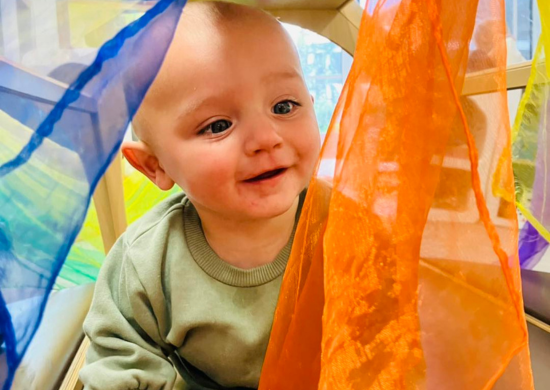
The first six months are all about bonding and sensory exploration. Babies are learning to trust the world around them through consistent care, cuddles, and communication.
Their brains are developing rapidly as they respond to your voice, facial expressions, and touch. During this time, babies begin to discover their bodies, their environment, and how to express their needs, usually through crying, cooing, and movement. These early months are foundational for emotional security and future learning.

Key Milestones:
- Smiling in response to others (around 6–8 weeks)
- Lifting head and beginning tummy time movements
- Making cooing and gurgling sounds
- Following moving objects with their eyes or moves head to sound of voices
- Makes eye contact when face-to-face with an adult about 20cm away or shuts eyes tight in bright light
How You Can Support Them:
- Provide skin-to-skin contact and responsive care
- Use eye contact, facial expressions, and calm voice when speaking
- Offer short, supervised tummy time daily
- Sing lullabies, talk during nappy changes, and read simple books
- Allow time for free movement on a soft mat or blanket
Seek Advice if:
- Child cries a lot
- Child arches their back
- Doesn’t respond to sound
- Isn’t showing interest when played with
- Doesn’t start making cooing or gurgling noises
6 to 12 Months: Exploring and Engaging
From six months onward, babies become more physically active and socially curious. They begin to move with more control, rolling, sitting, and eventually crawling, allowing them to explore their world in new ways. Language development picks up speed as they babble and experiment with sounds.
This is also a stage where separation anxiety may emerge, showing that your baby has formed strong attachments. Their growing independence is a sign of healthy development, even as they still rely on your guidance and reassurance.

Key Milestones:
- Sitting without support
- Rolling both ways and beginning to/ able to crawl
- Babbling (e.g., “ba-ba,” “da-da”) and responding to their name
- Showing preferences for certain people or toys
- Starting to pull self to standing position when hands are held
How You Can Support Them:
- Encourage exploration with safe, sensory-rich toys
- Play simple games like peekaboo to build social skills
- Support crawling and movement in open, safe spaces
- Read picture books with simple, repetitive language
Seek Advice if:
- Child isn’t making or learning new noises/sounds
- Not responding to familiar faces
- Isn’t learning to roll when playing on the floor
- Child doesn’t play with their feet or swaps objects between hands
- Doesn’t begin sitting, crawling, or pulling to stand
12 to 18 Months: First Steps Toward Independence
Between 12 and 18 months, Toddlers begin to express their independence in exciting (and sometimes messy!) ways. This is a stage of rapid physical development, many children take their first steps around their first birthday, and their curiosity about the world increases as their mobility improves.
At the same time, their communication skills are emerging, with first words, gestures, and emotional expressions becoming more intentional. It’s a time of big emotions, trial and error, and learning through play, exploration, and connection.

Key Milestones:
- Walking independently or with support
- Saying a few recognisable words like “mama” “dada” or “ball”
- Pointing to express interest or ask for things such as water, food, or toys
- Responding to simple instructions such as “can you pass me that”
- Showing interest in copying adult actions (such as brushing hair)
How You Can Support Them:
- Offer encouragement and praise for attempts, not just success
- Narrate daily routines and name objects to support language growth
- Provide safe spaces to explore and practice walking or climbing
- Engage in pretend play with simple props (e.g., cups, dolls)
Seek Advice if:
- Child isn’t using words or actions to communicate such as raising arms to be lifted or waving
- Child doesn’t want to move around
- Isn’t responding to others
- Not seeking attention of familiar people
18 to 24 Months: Communication and Curiosity
Between 18 and 24 months, Toddlers begin to show more personality, independence, and determination. They’re learning that they are separate from others and may start testing boundaries, an important part of social-emotional development.
Language begins to develop rapidly during this time, with Toddlers going from using a handful of words to combining two or more into short phrases. Their curiosity is constant, and they learn best through hands-on play, repetition, and exploration of the world around them.

Key Milestones:
- Using 10–50 words and beginning to form simple two-word phrases such as “more milk”
- Running, climbing, and kicking a ball
- Engaging in pretend play such as feeding a doll or pretending to talk on the phone
- Following simple two-step instructions
- Showing increasing independence such as wanting to feed themselves or choose clothes
How You Can Support Them:
- Read books with repetition and rhythm to boost vocabulary
- Offer choices to encourage independence “Do you want the red cup or the blue one?”
- Play simple pretend games and let them lead
- Use positive language and clear limits to guide behaviour
- Celebrate efforts in self-help skills like feeding or packing away toys
Seek Advice if:
- Child has trouble seeing or hearing things
- Child doesn’t say any single words
- Can’t put two words together such as “more drink”
- Doesn’t point, wave, or use other gestures
2 to 3 Years: Confidence, Curiosity, and Communication
Between the ages of 2 and 3, Toddlers become more confident in their physical abilities, language, and self-expression. This stage is often called the “Toddler Explosion” because of the rapid growth in vocabulary and social understanding.
Children begin to speak in short sentences, engage more in imaginative play, and show a desire to do things on their own. While emotions can still run high, Toddlers are starting to understand basic rules, routines, and how to express themselves in more complex ways. This is also when many children begin showing interest in toilet learning and self-help skills.

Key Milestones:
- Speaking in 2–4 word phrases and naming familiar people and objects
- Running, jumping, climbing, and kicking or throwing a ball
- Showing interest in playing alongside or with other children
- Engaging in pretend play for example, cooking, doctor, or animals
- Beginning toilet learning or showing signs of readiness
How You Can Support Them:
- Encourage conversations by asking open-ended questions and giving time to respond
- Offer opportunities for imaginative and messy play
- Support toilet learning with patience, consistency, and positive reinforcement
- Provide simple tasks to encourage independence such as tidying toys, putting on shoes
- Label and validate emotions to help them learn self-regulation
Seek Advice if:
- Child is not interested in playing
- Is falling a lot
- Finds it hard to use small objects
- Isn’t interested in food
- Not using many words or not understanding simple instructions
3 to 4 Years: Imagination, Social Skills, and Growing Confidence
The 3- and 4-year-olds are full of imagination, big ideas, and growing social awareness. Between ages 3 and 4, children begin to form stronger friendships, understand routines, and engage in more cooperative play. Their communication becomes clearer and more complex, allowing them to ask questions, tell stories, and express emotions in words.
At this stage, children often enjoy creative activities like drawing, painting, and role play, and they start to develop early numeracy and literacy skills through everyday experiences. This is also a key time for building emotional resilience, problem-solving, and a sense of self.

Key Milestones:
- Speaking in full sentences and asking lots of “why” and “how” questions
- Playing cooperatively with peers and taking turns
- Recognising basic colours, shapes, and counting to 5 or 10
- Drawing simple shapes or people with a few body parts
- Dressing themselves with minimal help
- Can tell the difference between being happy, sad, angry, or scared.
How You Can Support Them:
- Encourage creative play with art supplies, costumes, and open-ended materials
- Read books daily and talk about the characters and storylines
- Support social play and gently guide conflict resolution
- Introduce basic counting, sorting, and early literacy in playful ways
Seek Advice if:
- Child is not able to have a conversation
- Isn’t interested in playing with other children
- Child is not understood by others
4 to 5 Years: Confident Learners Preparing for School
Between the ages of 4 and 5, children step into a new level of confidence, curiosity, and capability. They’re developing stronger memory, problem-solving skills, and emotional awareness, and many begin showing an eagerness to learn about the world around them. Socially, they’re more cooperative, empathetic, and able to engage in group activities.
This stage often includes the transition into a more structured learning environment, such as a kindergarten program, where they build the foundational skills needed for a positive start to school. While they’re becoming more independent, they still rely on secure relationships and supportive routines to thrive.

Key Milestones:
- Speaking clearly and using more complex sentences
- Recognising letters, numbers, and their own name in writing
- Showing empathy and understanding of others’ feelings
- Drawing recognisable objects and writing some letters
- Following rules and routines with greater independence
How You Can Support Them:
- Talk positively about school and introduce daily routines that mirror a school day
- Read books with rich language and ask open-ended questions
- Encourage problem-solving during play and everyday tasks
- Support friendships and social learning through group games and role play
- Provide opportunities for fine motor practice such as drawing, cutting, threading beads
Seek Advice if:
- Child has speech fluency problems or is stammering with words
- Isn’t understood by others
- Unable to have a conversation
- Is not able to go to the toilet or wash themselves
While all children develop at their own pace, milestones offer a helpful guide for what to expect and when. Tracking these developmental stages can help identify areas where your child may need extra support and celebrate the amazing progress they’re making.
In Australia, your child’s health and development are monitored through regular child health checks. You can use your child’s Personal Health Record to keep track of milestones and speak with your child health nurse or GP if you ever have concerns.
At Children First Early Education, we know the first five years are critical in laying the foundation for future learning and success. Our Early Childhood Educators are trained to support each child’s unique journey, with play-based learning, nurturing routines, and strong relationships at the heart of everything we do.
We’re here to support you, too. If you have questions about your child’s development, our team is always happy to help.
Follow us on Facebook to keep up to date with our Children First Early Education centres and see how we support children's milestones in action:
- Children First Cranbrook
- Children First Fairfield
- Children First Gaythorne
- Children First Underwood
- Children First Walkervale
- Children First Mernda
- Children First Mitcham
- Children First Evanston Park
- Children First Salisbury Downs
- Children First Angle Vale
- Children First Ingle Farm
- Children First Lightsview
- Children First Lindisfarne
- Children First South Hobart
Children First Berserker is opening soon. Follow them on Facebook to receive regular updates on their progress.