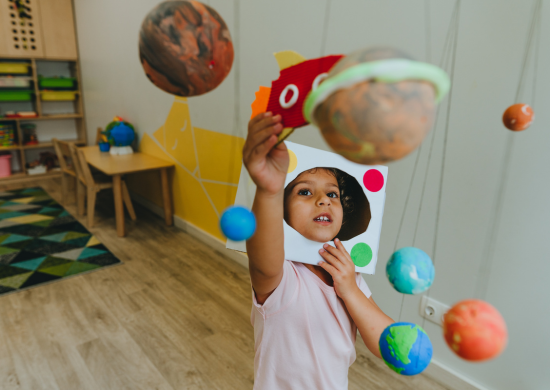
This week across our Children First Early Education centres, children have been reaching for the stars as we celebrate Space Week 2025. Our Educators have been sparking curiosity about the wonders of the universe through play, creativity, and exploration.
From glowing stars and swirling planets to astronauts floating in zero gravity, space is a topic that instantly excites children, there’s something truly magical about exploring what lies beyond our planet and for young children, learning about space isn’t just about facts and science, it’s about nurturing wonder, discovery, and a love for learning.
While Space Week is a wonderful opportunity to focus on the cosmos, our Educators and Curriculum Teams work together to find ways to nurture curiosity about science and discovery all year round.
Introducing early concepts of space in early education helps children:
Develop curiosity and questioning skills, “What’s out there?” “Why do stars twinkle?”
Explore STEM (Science, Tech, Engineering, and Math) concepts in playful ways such as counting planets, building rockets, or comparing sizes and shapes.
Engage their creative thinking through imaginative play by pretending to be astronauts, aliens, or scientists.
Strengthen language and literacy learning new words such as “orbit,” “gravity,” or “galaxy.”
When space is introduced through hands-on, age-appropriate experiences, it becomes a gateway for big thinking and helps children connect what they know about their world to what exists beyond it.
Across our Children First Early Education centres, Educators bring the theme of space to life through creative, sensory, and play-based learning experiences.
Here are just a few of the ways children explore the cosmos at Children First Early Education:

One of the children’s favourite experiences is creating paper mâché planets. Using balloons, newspaper, and paint, children can design their own colourful versions of the solar system. This activity offers so much more than just art, it becomes a rich opportunity for learning and skill development.
As children shape and paint their planets, they also develop fine motor skills through tearing, gluing, and brushing, express their creativity by choosing colours and textures, and strengthen their scientific thinking as Educators guide conversations around the planets’ sizes, orbits, and characteristics.

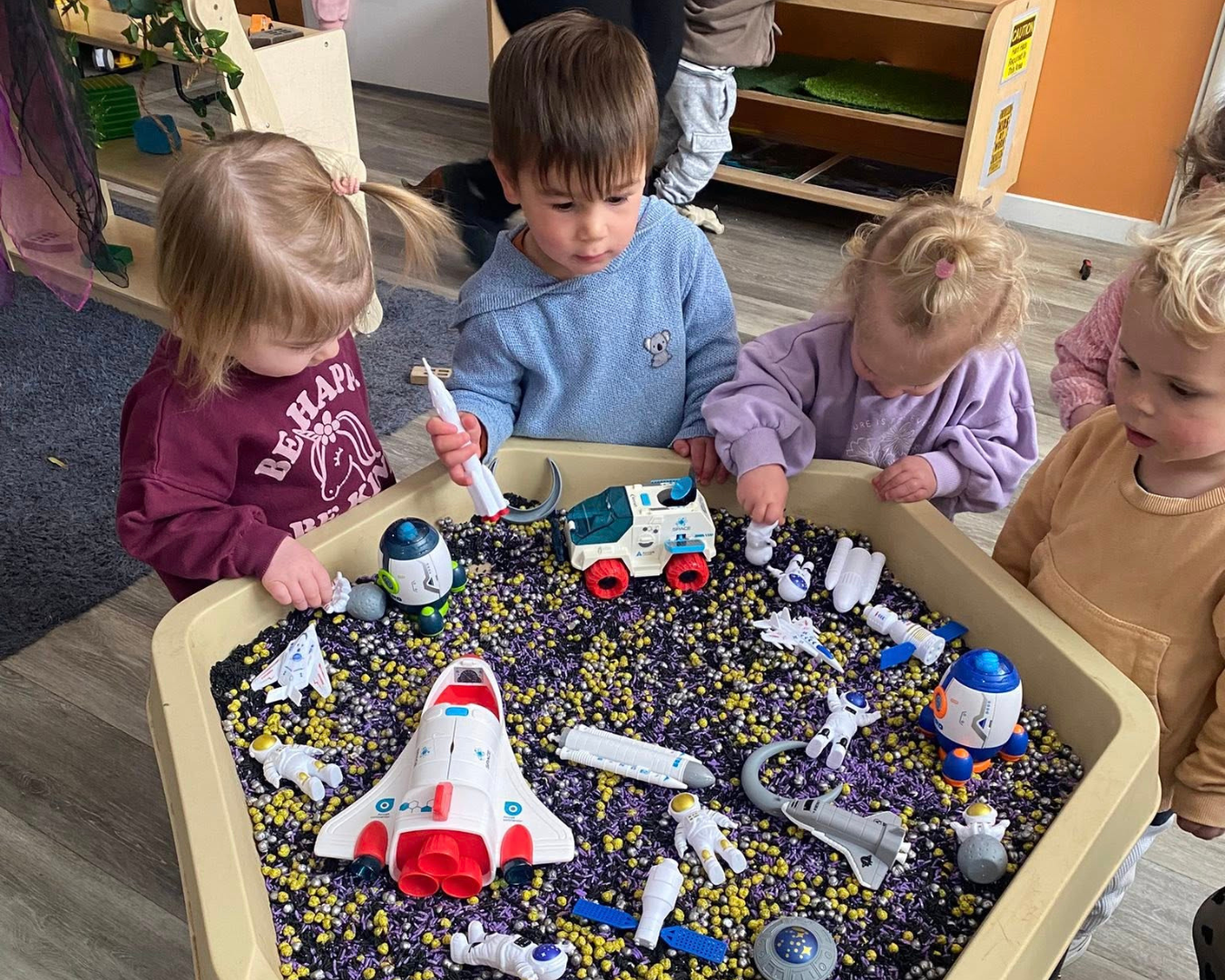
Another engaging experience is exploring space-themed sensory trays, filled with foil, natural materials such as wood, cotton, and rocks, and cut-outs of moons, rockets, and friendly aliens. This inviting setup encourages children to explore different textures, materials, and imaginative ideas as they play.
As children scoop, sort, and create stories within the tray, they develop their sensory awareness, fine motor coordination, and language skills, while also building an understanding of how materials and environments can represent the world — and universe — around them.

Painting planets is another classic Space themed activity where children add colour and texture to paper cut-outs representing the planets of our solar system. Using brushes, cotton buds, or fingers, children experiment with mixing and applying paint, creating unique patterns and designs.
This creative experience supports the development of fine motor skills as children hold and control tools, express their creativity through colour and pattern choices, and build early scientific understanding as educators talk about the planets, their colours, and positions in the solar system. It’s a hands-on way to make the universe feel close, exciting, and full of possibilities.
Each of these experiences encourages children to think like little explorers, asking questions, making predictions, and sharing their discoveries with peers.
Exploring space connects seamlessly to many areas of the Early Years Learning Framework (EYLF), including:
Outcome 4: Children are confident and involved learners — as they experiment, investigate, and problem-solve through play.
Outcome 5: Children are effective communicators — as they express ideas, share knowledge, and engage in rich conversations about what they discover.
Outcome 2: Children are connected with and contribute to their world — as they begin to understand their place in the wider universe.
Through these experiences, children not only learn about space, they learn about possibility. They dream, imagine, and explore the idea that there’s so much more to discover.
By turning space into a hands-on, sensory-rich experience, our Educators are building a foundation for lifelong curiosity and learning.
Follow us on Facebook to stay up to date with each of our Children First Early Education centres and explore how they celebrate Space:
- Children First Berserker
- Children First Fairfield
- Children First Cranbrook
- Children First Gaythorne
- Children First Underwood
- Children First Walkervale
- Children First Mernda
- Children First Mitcham
- Children First Evanston Park
- Children First Salisbury Downs
- Children First Angle Vale
- Children First Ingle Farm
- Children First Lightsview
- Children First Lindisfarne
- Children First South Hobart
Children First Gympie and Children First Keperra are opening soon. Follow them on Facebook to receive regular updates on their progress.